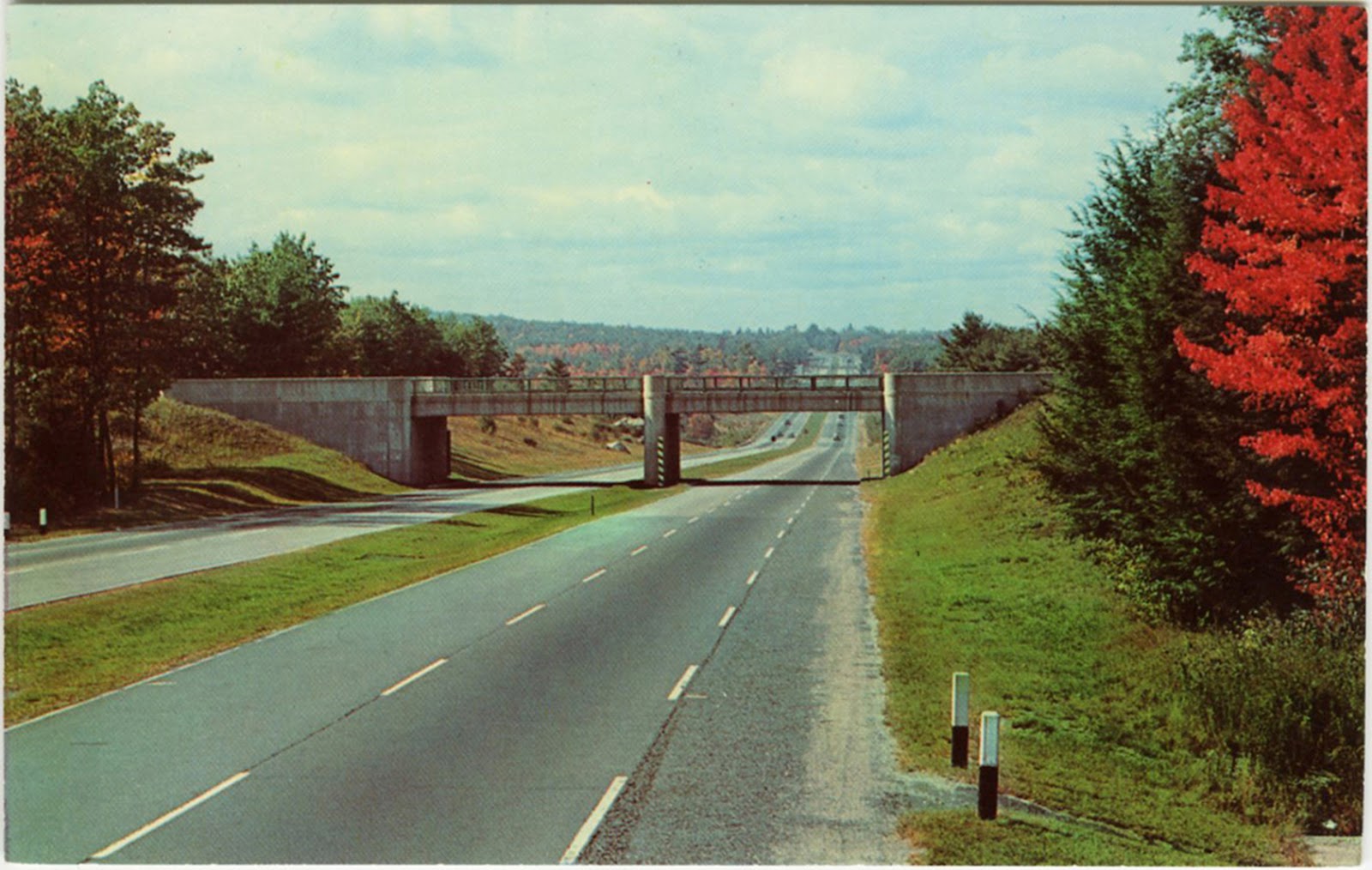
Less than 40 years after this proud postcard hit the streets, the General Motors plant in Janesville closed. Employing thousands of people over the decades, production at the plant ceased on December 23, 2008. The last Chevy Tahoe that rolled off the production line that day was raffled to raise funds for the United Way. Janesville wasn't the only Wisconsin town to make cars, Kenosha, Milwaukee, Oshkosh, Racine and more did too. From the Kissel Kar, made in Hartford, to the Excalibur designed by Brooks Stevens to the Little Nash Rambler, Wisconsin is known to be home of about three dozen motor vehicle makers. As the 20th century wore on, workers making cars gave way to artists using them as subject matter, medium, and process. In 1953, Robert Rauschenberg asked composer John Cage to drive his Model A Ford over 20 sheets of paper to make Automobile Tire Print. Starting in 1959, John Chamberlain made automobile "collage" sculptures. The Ant Farm buried 10 Cadillac fins-up along Route 66 in 1974 to make Cadillac Ranch, oft referred to as the most famous public art work in America. Artists and entrepreneurs have found that cars transport both the body and the mind making for eerie associations. That same year, performance artist Chris Burden had himself crucified to a VW Beetle for his Trans-Fixed piece. We remember seeing Bonnie Parker and Clyde Barrow's bullet-riddled 1934 Ford V8 getaway car displayed in a semi-trailer in a shopping mall parking lot in the 1970s. These days it's on display for free at a casino/hotel near Las Vegas. An upcoming gallery exhibition in Miami called Piston Head: Artists Engage the Automobile examines the use of the car in art since 1970. The organizers argue that cars are the symbol of American consumerism and the "quintessential machine of modern life." The show features work by trendy contemporary artists like Richard Prince whose Hood series uses 1960s muscle car hoods to conjure dreams fueled by a desire to escape and the Bruce High Quality Foundation, an enigmatic art collective that deployed an entangled Volkswagon in a recent work. Displayed in the context of a parking ramp at one of the biggest international art events of the year, the car becomes sacred icon and cathedral (Barthes). Meanwhile in Kenosha, Janesville, and Milwaukee, the car plants have been abandoned or have disappeared altogether.
Showing posts with label Kenosha. Show all posts
14.11.13
Found: General Motors Corp, Janesville, WI
Labels:
Ant Farm,
Brooks Stevens,
Cadillac Ranch,
Chevrolet,
Excalibur,
factory,
G.R. Brown Co.,
General Motors Corp.,
Janesville,
John Chamberlain,
Kenosha,
Kissel Kar,
Piston Head,
Rock River,
Wisconsin
Location:
Janesville, WI, USA
29.9.13
1949 Nash Ambassador Super Four-Door Sedan
![]() |
| 1949 Nash Ambassador Super Four-Door Sedan with 1800s Stone Shed, Polifka Corners, Whitelaw, Wisconsin, July 2013 © J. Shimon & J. Lindeman |
Nash Motors Company of Kenosha, Wisconsin, was so dedicated to the idea of aerodynamics that it charged $9 extra for the George Petty-designed flying lady hood ornament on its 1949 Ambassador sedan. The plush, post-war "Airflyte" Ambassador featured technological innovations such a single welded "unibody" (frame and body are one), enclosed front wheels, (hydramatic) automatic transmission, and reclining seats that formed a twin bed. Known as the "make-out" auto of choice by the teens of the 1950s, the Ambassador had a streamlined tear-drop shaped back, cockpit-like instrument panel with uniscope instrument grouping, and a spaceous trunk. Referred to as "Miss Upside-Down Bathtub of 1949" by Tom McCahill in Mechanix Illustrated, it sold for about $2,200 and was alternately called the "Kenosha Cadillac" or "Kenosha Duesenberg." Just a little over a half-century later, the former Nash Motors factory on 110 acres near Lake Michigan was considered a blight. After morphing into Nash-Kelvinator then American Motors (AMC) then Chyrsler, the plant closed in 2010 and demolition began in December 2012. Surviving Ambassadors remain as a monument to the idealism of an American ingenuity that believed in the possibility of a faster and sleeker vessel to transport the human body through space and time. We purchased a 1949 Ambassador from a guy named Kurt in Idaho Falls, Idaho in November of 2012 for about the original selling price including shipping. The last time he started the car before sending it on its way to our farm in Wisconsin, Kurt said "she purred like a kitten." And she did. On Thursday, September 26, 2013 John Shimon, accompanied by artist Matt Chung, drove the auto through the Wisconsin countryside passing corn fields, verdant forests, and an aqua Lake Michigan to the John Michael Kohler Arts Center. On the trip, it got 25-30 miles per gallon due to its economical 6-cylinder engine, overdrive transmission, and aerodynamic body design. As part of our WE GO FROM WHERE WE KNOW exhibition at the JMKAC, it will be filled with over 1,000 cast concrete corn cobs memorializing a childhood memory of a Nash repurposed as a corn crib while contemplating the contemporary role of corn as food and fuel in the US. Matt Chung made this video documenting the journey:
Labels:
1949 Nash Ambassador,
Airflyter,
Kenosha,
Nash Motors Company,
Wisconsin
Location:
Kenosha, WI, USA
19.9.12
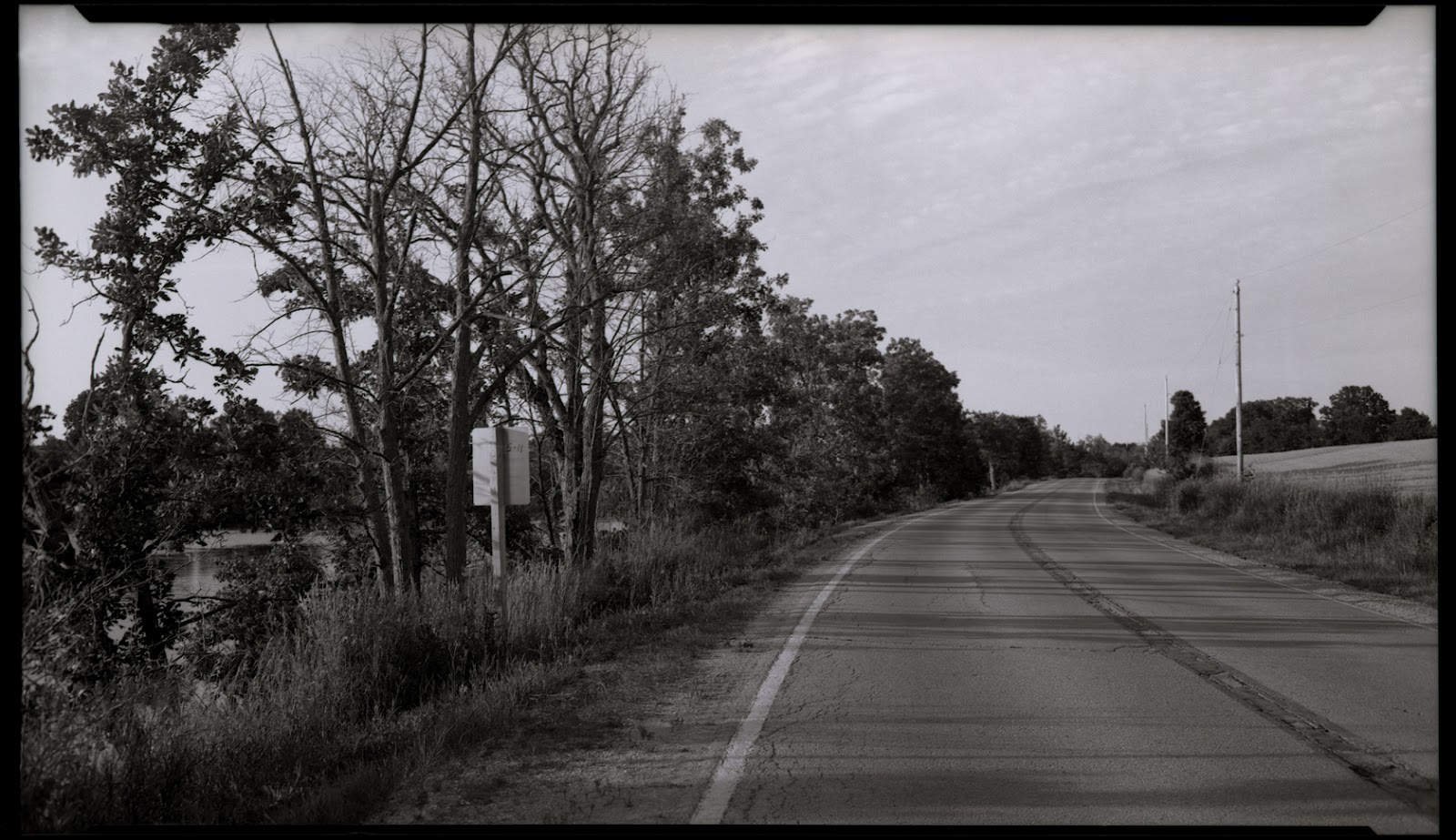
County ZZ, Wrightstown, WI
![]() |
| County ZZ, Wrightstown, Wisconsin, June 30, 2012 |
![]() |
| Found: "Highway Scene, U.S. 16 and 12, Camp Douglas, Wisconsin" by Wayne Paper Box & Printing, Fort Wayne, Indiana, circa 1950s |
![]() |
| Found: "River Drive, Cornell, Wis." on DOPS paper, circa 1938 |
![]() |
| Found: "Highway 130, Lone Rock, Wisconsin, on EKKP paper, circa 1930 |
![]() |
| Found: "Scene at Minocqua, Wis." on DOPS paper, circa 1941 |
![]() |
| Found: "A Pleasant Drive Near Rio, Wisconsin," circa 1910 |
![]() |
| Found: "James Street, Columbus, Wisconsin" by E. A Bishop Publishing, Racine, Wis., circa 1930 |
![]() |
| Found: "'At the Turn of the Road'" Potowatomi State Park, Door County, Wisconsin" by E. A. Bishop Publishing, Racine, Wis., postmarked July 3, 1944 |
![]() |
| Found: "Prairie Avenue, Kenosha, Wisconsin," by E. A. Bishop Publishing, Racine, Wis., postmarked May 7, 1909 |
![]() |
| Found: "Driveway, Humboldt Park, Milwaukee, Wisconsin," by M.L. Anneberg Publisher, Milwaukee, postmarked December 31, 1911 |
![]() |
| Found: "A Pleasant Drive, Omro, Wisconsin, by National Colortype Co, circa 1950 |
![]() |
| Found: "The Drive, Lake Side Park, Fond Du Lac, Wis." published by the Acmegraph Co, Chicago, circa 1920 |
![]() |
| Found: "Grand Dad's Bluff, La Crosse, Wis." published by Spencer-McCord Drug Co., La Cross, Wis., circa 1940 |
![]() |
| Found: "One of many Beautiful Drives near Baraboo, Wis." by Baraboo News Agency, Baraboo, Wis, circa 1930 |
![]() |
| Found: "Road Scene, Trail 3, Near La Crosse, Wis." published by Spence-McCord Drug Co., La Crosse, Wis, circa 1940 |
![]() |
| Found: "Road to the Lake: At the end of this birch lined lane are the invited waters of an inland lake, Vacationland Scwne" copyright The L.L. Cook Co., Milwaukee, Wisconsin, 1954 |
![]() |
| Found: "A Modern Super-Highway thru the Grandeur of Autumn" photo by Free Lance Photographers Guild, Inc. published by C. R. Brown Co., Eau Claire, Wis, circa 1960 |
![]() |
| Found: "Greetings from Rhinelander, Wisconsin, Lookout," published by Wyman Post Card Co, Wausau, Wis, circa 1960 |
Duane Hall confessing his psychopathic driving urges, scene from Annie Hall
Driving the rural back roads of 21st century Wisconsin isn't as romantic as the vintage postcards we've posted once portrayed it when gawking at the landscape was the only concern. Now there are texting teens, liquid manure spills, and farm implements wider than the road. The "picturesque" mid-century roadways depicted on postcards invited folks to jump in their cars with family and friends to motor to destinations throughout the state. Fall colors, rivers, scenic bluffs, and parks peppered the landscape. Being an attentive driver or "keeping your eyes on the road" seemed beside the point. A perfectly neurotic Wisconsin night driving movie scene is a highlight of Woody Allen's 1977 film Annie Hall. New York City comic Alvy Singer (played by Woody Allen) and night club chanteuse Annie Hall (played by Diane Keaton) visit her home town of Chippewa Falls, Wisconsin. Singer's Manhattan aversion to driving plays out in a scene with Annie Hall's brother Duane (played by Christoper Walken) confessing his psychopathic driving urges in his dimly lit bedroom: "Sometimes when I'm driving on the road at night and I see two headlights coming toward me fast, I have this sudden impulse to turn the wheel quickly head-on into the oncoming car. I can anticipate the explosion, the sound of shattering glas, the flames rising out of the flying gasoline..." Modern Super-Highways with their smooth curves, reinforced dividers, and fenced-off roadbeds eliminate many rural hazards as drivers zoom between cities and suburbs. Still, the back roads remain the most intriguing Wisconsin driving as they weave through the glacial Wisconsin landscape, small towns, and woods with lush trees arching overhead.
![]() |
| Found: Antigo by Curteichcolor® 3-D Natural Color Reproduction and Antigo Card Service, Antigo, Wisconsin, circa 1960 |
Labels:
Baraboo,
Columbus,
Cornell,
Door County,
Eagle River,
Fond du Lac,
Humboldt Park,
Kenosha,
La Crosse,
Lone Rock,
Milwaukee,
Minocqua,
Prairie Du Chien,
Rhinelander,
Rio,
Wisconsin,
Wrightstown
Subscribe to:
Posts (Atom)